
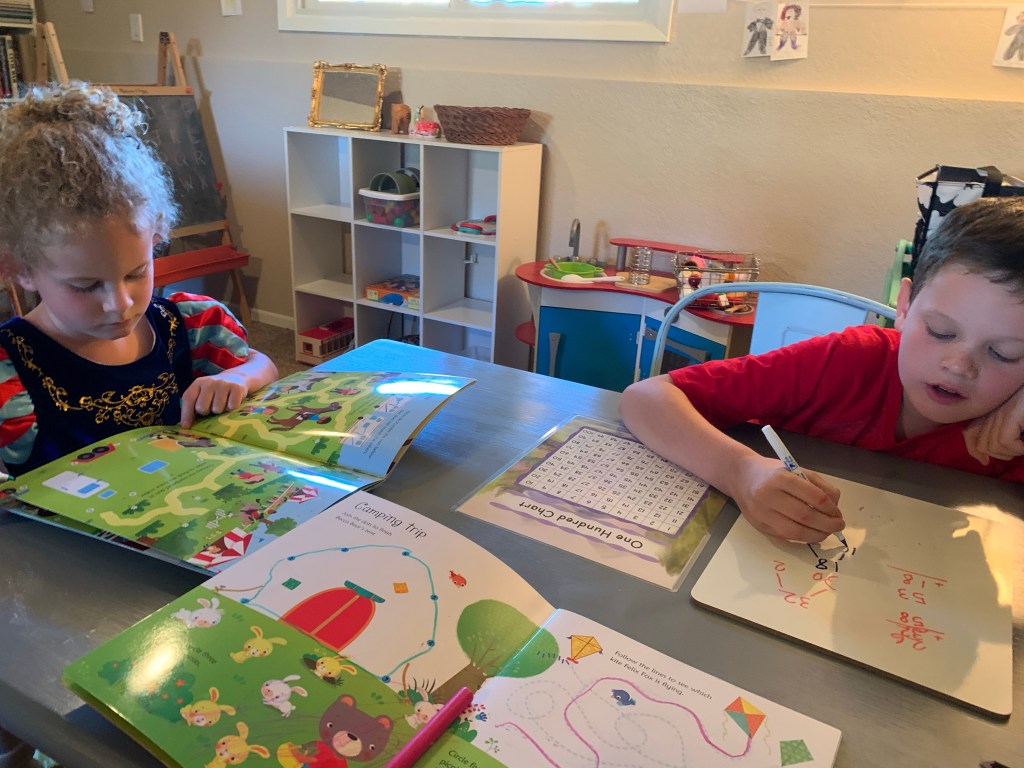
Last week, I gave a little peek inside to our morning time, where we share a hymn, memory verse, some Spanish, solfa, and picture study (alongside a healthy dose of playdough and crayons). Today here’s a peek inside the next part of our homeschool day: table time!
I chose the term table time because “school time” was giving the impression that this short time of the day was the only time we did our learning. It’s not. Learning is an all day affair, and I want my kids to feel that. I want them to know that when we’re baking, or exploring nature, or meeting up with friends at a local pool or gym – all of that is learning. Table time reflects that this is our time of learning where we sit down and focus in a different way, and that mom (at this point in our homeschool journey) has scheduled teachings. Because morning time takes only about 10-20 minutes, we’re usually starting table time around 9:15-9:30.
The first part of our table time is math. I like to focus on math straight-away, because in Charlotte Mason’s first volume, she recommended giving our biggest brain-power to math from the get-go. I saw with my oldest the difference in his attention span and ability to work through problems when we shifted from math later in the day to math right away. Another change that made a big difference for us was following Charlotte Mason and AmblesideOnline’s recommendations to keep math at 15 minutes. I know – I was really nervous when I first read that. How on earth can we actually accomplish anything in 15 minutes?! Giving it a try though, I found we had less meltdowns and more information retained when we kept things short and sweet. (Side note: this doesn’t mean we’re not doing math at other times of the day. We use math in baking/cooking, playing games, and in randomly figuring out real-life math problems that come our way. This 15-minute slot is just the formal learning time for math.)
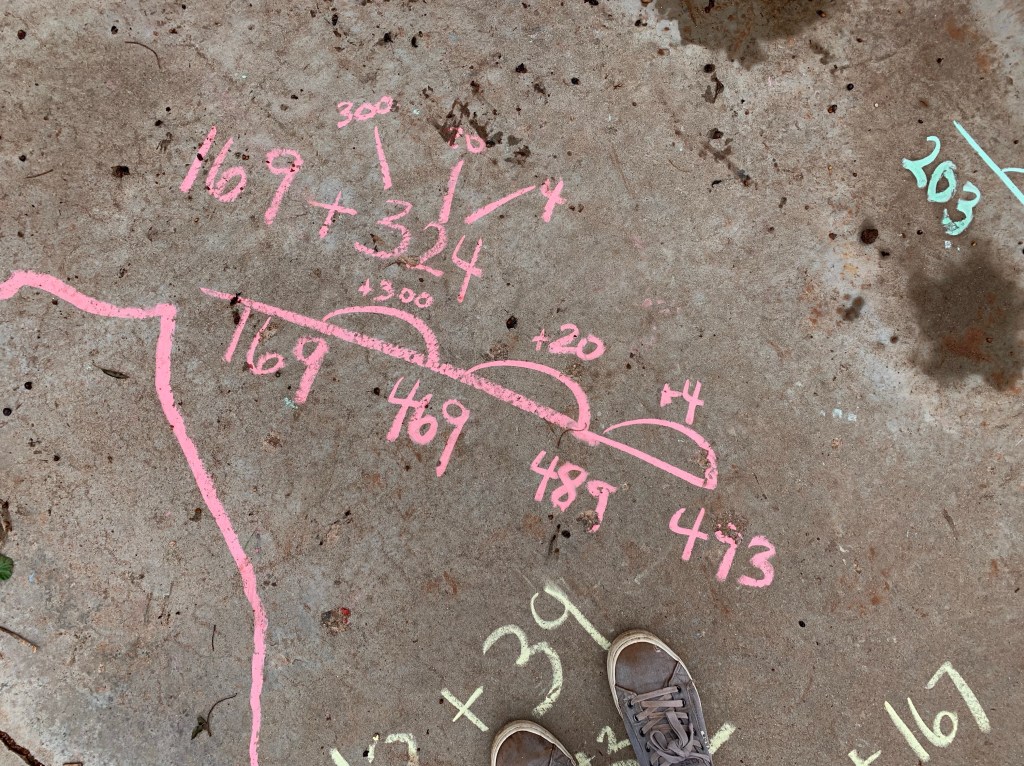
For my kindergartener, math is woven into this time or after it. For example, today for my 8-year-old’s math we were timing various things to compare length of time. We decided it would be fun timing how long it took to count to 100… bingo! Practicing counting to 100 happened right there for my 5-year-old.
(I know there will be those who are curious, so I’ll put it in here. We use Wild Math and The Good and The Beautiful Math currently. AmblesideOnline has a wealth of information regarding math, including on their forum; and Charlotte Mason’s Volume 1 goes into great detail on math work in the early years.)
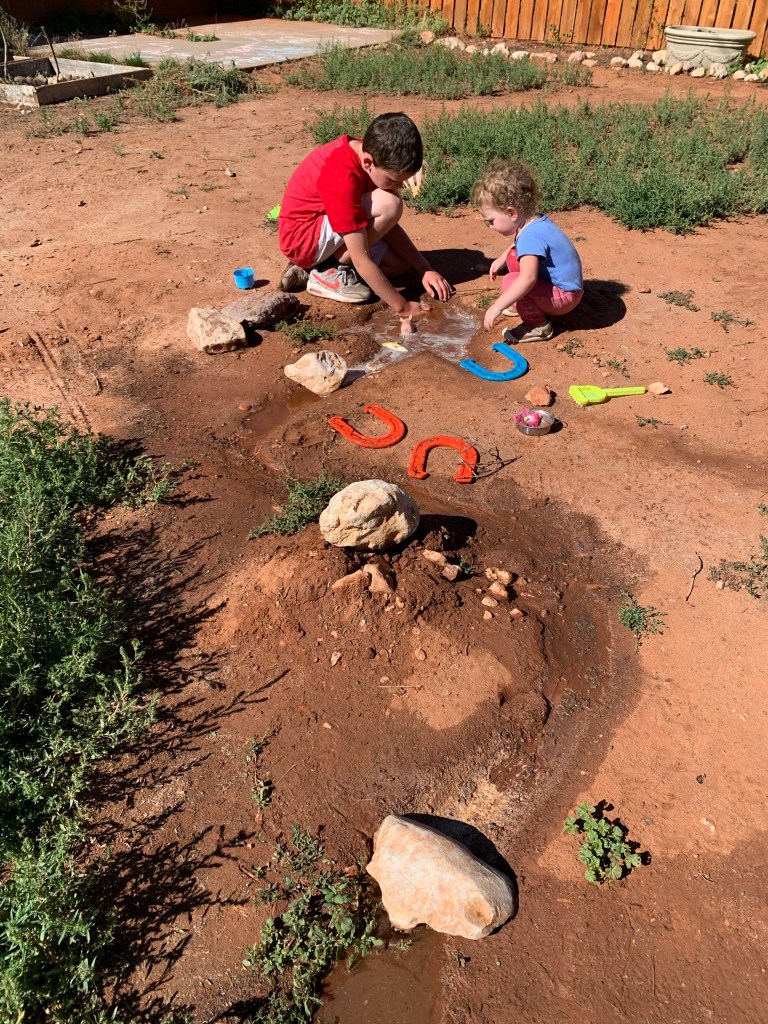
After math, my two littlest (5 and 1) play together while I work with my 8-year-old. We try to take this time outside as often as possible so the younger kids are getting plenty of fresh air and exercise and exploring. I usually have chalk out for them, the hose at a trickle with some buckets / dirt / spoons, or they’ll wander to our outdoor kitchen and make soups and pies with flowers and mud.
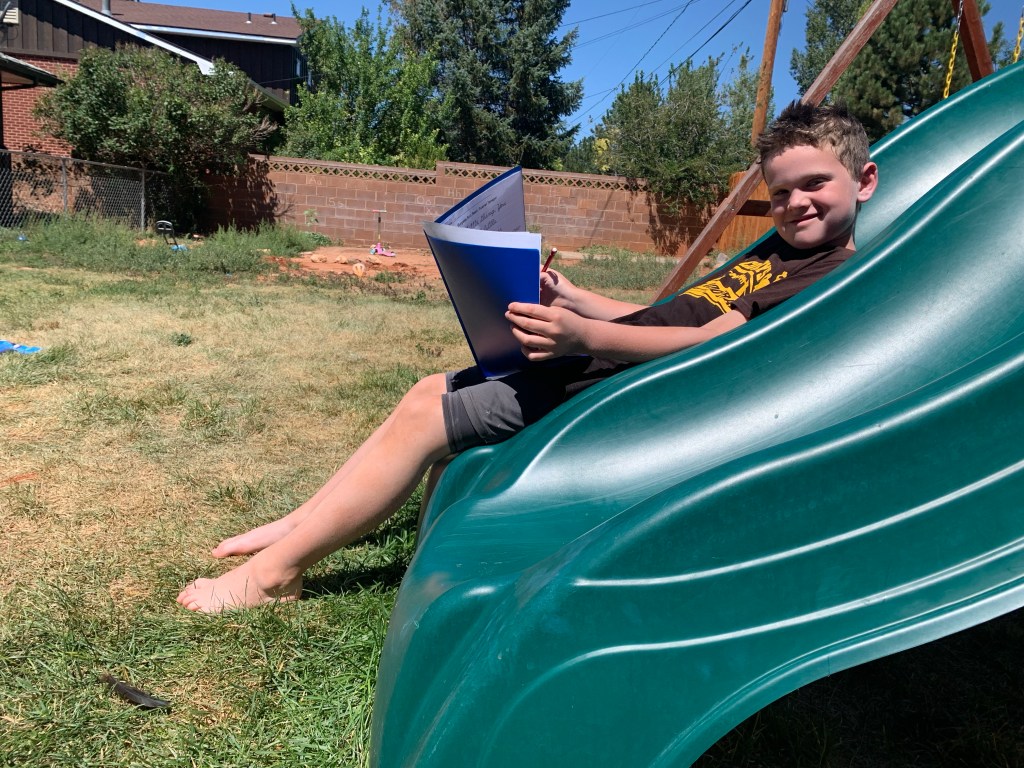
While they’re (most of the time) happily wandering about, I continue table time with my oldest. For my 8-year-old, we follow the AmblesideOnline scheduled readings for Year 2 and alternate them with copywork and Spanish. So it goes a bit like this: reading #1, copywork, reading #2, Spanish, and reading #3. Breaking up the readings with other things helps with retention and (even more importantly) developing the power of attention. Each of those bits are about 10 minutes long, so we’re generally done with his table time in 50 minutes.
Granted, we naturally have interruptions from my 1-year-old and 5-year-old during that time. They need help opening things, or finding things, or have a question, or need guidance in being kind / sharing / etc. I try to remember that these interruptions are just as important as the table time I’m doing with my oldest. They show my younger kids they are loved and valued, and that it is just as important for me to guide them as for big brother. I also know that over time, they’ll learn to be more self-sufficient. Some days are more heavy on interruptions than others, but generally we are done with table time by 11 a.m.
(A quick word on the AmblesideOnline curriculum…. this curriculum and the Charlotte Mason philosophy of education has brought so much *joy* to our homeschool days. I would say they were overall very joyful before, but it’s at least ten-fold what it was prior to using the AO curriculum. My oldest begs for his readings, and the kids (and I) have been enjoying so much beauty that we weren’t experiencing before. I highly encourage looking into the Charlotte Mason philosophy of education. You can find her volumes for free on AmblesideOnline, or pay for them in print from Living Book Press. I also enjoy listening to The New Mason Jar by Cindy Rollins.)
Ok – to continue with our homeschool day! After table time ends, we have an hour of free play. My 8-year-old is free to explore his own interests (sometimes building in mud, or drawing, or reading; today he was learning with his microscope and slides). That’s one of the beautiful things about homeschool, and particularly about Charlotte Mason education in my experience: I expect very close attention during our formalized learning time, and then the kids have time to explore their interests in their informal learning time.
Speaking of informal learning time, I’ll be diving into that next week. This is the part of our day that includes games and puzzles, poetry tea time, speech + literacy for my 5-year-old, playing with friends, and sports / physical education.
Let me know if you have any questions about our table time!
 A Little Golden Thread